Cognitive Support Formula
Memocept Review: Sharper Memory, Better Focus & Mental Clarity
A long, honest look at the Memocept cognitive support formula, what is inside each 60-capsule bottle, who it suits, how quickly people notice a difference and what the official pricing and 60-day guarantee actually cover.
60-day money-back guarantee · Ships from the official store
Why memory slips before anything else
Almost nobody wakes up one morning and decides their memory has gone. It happens quietly. You walk into the kitchen and forget the reason. You read a paragraph three times and still could not repeat it. A name you have known for fifteen years sits somewhere just out of reach while you smile and hope the conversation moves on. None of these moments are dramatic on their own, which is exactly why they are easy to write off as tiredness, stress or simply a busy week.
The pattern usually shows up in the mid-thirties and becomes hard to ignore in the forties and fifties. Part of it is the brain itself: the rate at which nerve cells communicate slows, blood flow to the smaller vessels in the brain becomes less efficient, and the day-to-day repair work the brain does on its own connections takes longer than it once did. Part of it is modern life. Short sleep, a permanently split attention span, endless notifications and long stretches of low-grade stress all tax the same system.
That is the space Memocept was built for. It is not marketed as a treatment for any medical condition, and this review will not pretend it is one. It is a daily nutritional formula intended to support the ordinary cognitive functions that most healthy adults would like to hold on to for longer: recall, concentration, processing speed and the clean feeling of mental clarity that makes work feel less like wading through fog.
What Memocept actually is
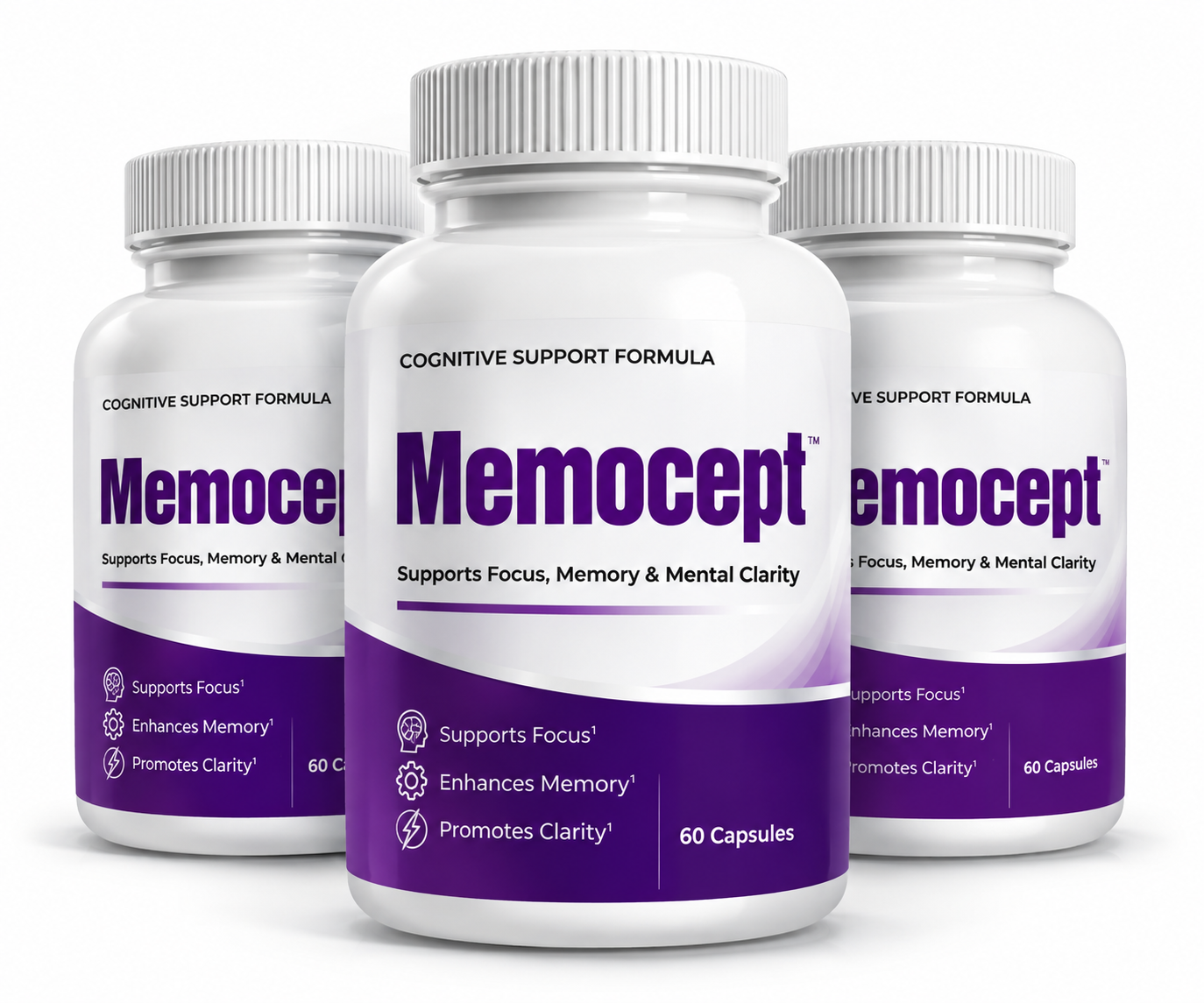
Memocept is a capsule-form cognitive support supplement. Each bottle holds 60 capsules, which is a 30-day supply at the label serving of two capsules per day. The front of the bottle carries three claims: supports focus, enhances memory and promotes clarity. Those are structure-and-function statements, which is the category nutritional supplements are legally allowed to speak in.
The presentation is deliberately plain. There is no proprietary gimmick on the label, no energy-drink styling, no promise of overnight genius. It reads like something meant to sit on a kitchen counter next to a vitamin D bottle and be taken every morning without thinking about it, which is honestly how any formula of this kind has to be used to be worth anything at all.
The manufacturer states that production takes place in a facility that follows Good Manufacturing Practice standards, that the capsules are non-GMO, and that each batch is tested for purity before it ships. Those are the baseline signals worth checking on any supplement, and they are the ones that separate a serious product from a white-label bottle assembled for a single ad campaign.
How the formula is meant to work
Cognitive formulas generally attack the problem from three angles at once, and Memocept is no exception. The first angle is circulation. Brain tissue is extraordinarily hungry: it takes roughly a fifth of the body's oxygen supply while accounting for a fraction of its weight. When the microvessels feeding the brain deliver less than they should, the first symptoms are exactly the ones people complain about — slow word-finding, a heavy head in the afternoon, having to reread things.
The second angle is neurotransmitter support. Acetylcholine in particular is the messenger most closely tied to learning and recall. Formulas in this category typically supply choline precursors so that the raw material for that messenger is not the limiting factor.
The third angle is protection and repair. Oxidative stress and low-grade inflammation wear down neural tissue over years, and antioxidant compounds are included to blunt that process. Alongside them sit adaptogens, which do not sharpen thinking directly so much as take the edge off the stress response that degrades thinking. Anyone who has tried to concentrate while genuinely anxious knows how much of cognitive performance is really stress management wearing a different hat.
Put together, the intent is not stimulation. Memocept is not caffeine in a capsule and should not be judged by whether you feel something thirty minutes after swallowing it. The design goal is a gradual, accumulating improvement in the conditions the brain works under.
The ingredient categories to look for
Rather than list a formula that could change between production runs, the honest thing to do is describe the categories a credible cognitive-support blend draws from and tell you to read your own bottle's panel against them.
- Bacopa monnieri — the most studied herb in this space, associated in trials with improved recall of new information after roughly twelve weeks of consistent use. It is slow, and that is the point.
- Ginkgo biloba — a long-standing circulation support ingredient, used for blood flow to small vessels including those in the brain.
- Choline sources such as Alpha-GPC or citicoline — direct precursors to acetylcholine, the memory-linked messenger.
- L-theanine — the amino acid from green tea that produces calm attention rather than the jittery kind.
- Rhodiola rosea — an adaptogen used against mental fatigue, particularly the kind that arrives late in a demanding day.
- Phosphatidylserine — a phospholipid found in neuronal membranes, associated with memory support in older adults.
- B-complex vitamins — B6, B9 and B12 sit at the centre of homocysteine metabolism, and elevated homocysteine is one of the better-documented nutritional risk factors for cognitive decline.
Two rules apply when you read any label. First, dose matters more than the ingredient list; a famous herb at a token amount is decoration. Second, a proprietary blend that hides individual amounts behind one total makes it impossible to tell whether the doses are meaningful. The more transparent the panel, the more confidence you can place in it.
What people report, and on what timeline
Reading through user feedback for products in this category, the reported experience follows a fairly consistent arc, and it is worth setting expectations against it before you buy anything.
Weeks one to two. Very little that anyone would call dramatic. The most common description is that mornings feel a shade less heavy and that the usual mid-afternoon slump is slightly shorter. A fair number of people notice nothing at all in this window, and that is normal.
Weeks three to six. This is where the useful reports begin. People describe holding concentration through a long task without drifting, following a meeting without losing the thread, and reaching for names with less hesitation. It is not a sudden change; most people only recognise it in hindsight.
Weeks eight to twelve. The window the research on herbs like bacopa points to for memory effects. Reports here focus on recall of recent information — where you put something, what was agreed yesterday, the details of a conversation — which is exactly the kind of memory that frustrates people most.
Beyond three months. Users who continue describe the benefit as maintenance rather than further gain: they stay at the better baseline they reached rather than climbing higher.
This timeline is the practical reason the three- and six-bottle packages exist. A single bottle is one month, and one month sits almost exactly at the point where most people have not yet had the experience they were hoping for. Buying one bottle to "test it" is the most common way people conclude that a formula like this does nothing.
Who it fits, and who should skip it
Memocept makes sense for adults over thirty who notice their focus is not what it was; for professionals whose work is mostly thinking and who feel their output drop in the second half of the day; for students and anyone learning something demanding; for people over fifty who want to support cognitive health proactively rather than reactively; and for anyone who has been running on short sleep for long enough that mental fog has become the default setting.
It is not right for everyone. Anyone under eighteen should skip it. Pregnant and nursing women should not take it without medical clearance. If you take blood thinners, blood pressure medication, antidepressants or anything for a diagnosed neurological condition, talk to your doctor first, because several common botanical ingredients interact with those categories. And if you are looking for treatment of a diagnosed condition, this is a supplement, not medicine, and it should not be a substitute for care.
How to take it for the best result
Two capsules daily with water, taken with a meal. Morning is the sensible default because it puts the ingredients into your system before the day's demands rather than after them, and because a meal improves absorption of the fat-soluble components.
Consistency beats everything else. Missing two or three days a week undermines the whole premise of a formula built on gradual accumulation. Attach the capsules to something you already do without fail — the first coffee, brushing your teeth — rather than trusting yourself to remember, which is faintly ironic given the product.
The unglamorous multipliers matter too. Seven hours of sleep does more for memory than any capsule, because consolidation happens overnight. Moderate exercise increases blood flow to the same vessels the formula is meant to support. Hydration alone accounts for a surprising share of afternoon fog. Taken together with those habits, a supplement has a real chance to show what it can do. Taken instead of them, it does not.
Memocept Pricing & Official Packages
Pricing is tiered by package size, and the six-bottle option carries the lowest per-bottle cost together with free shipping. Every package is backed by the same 60-day money-back guarantee.
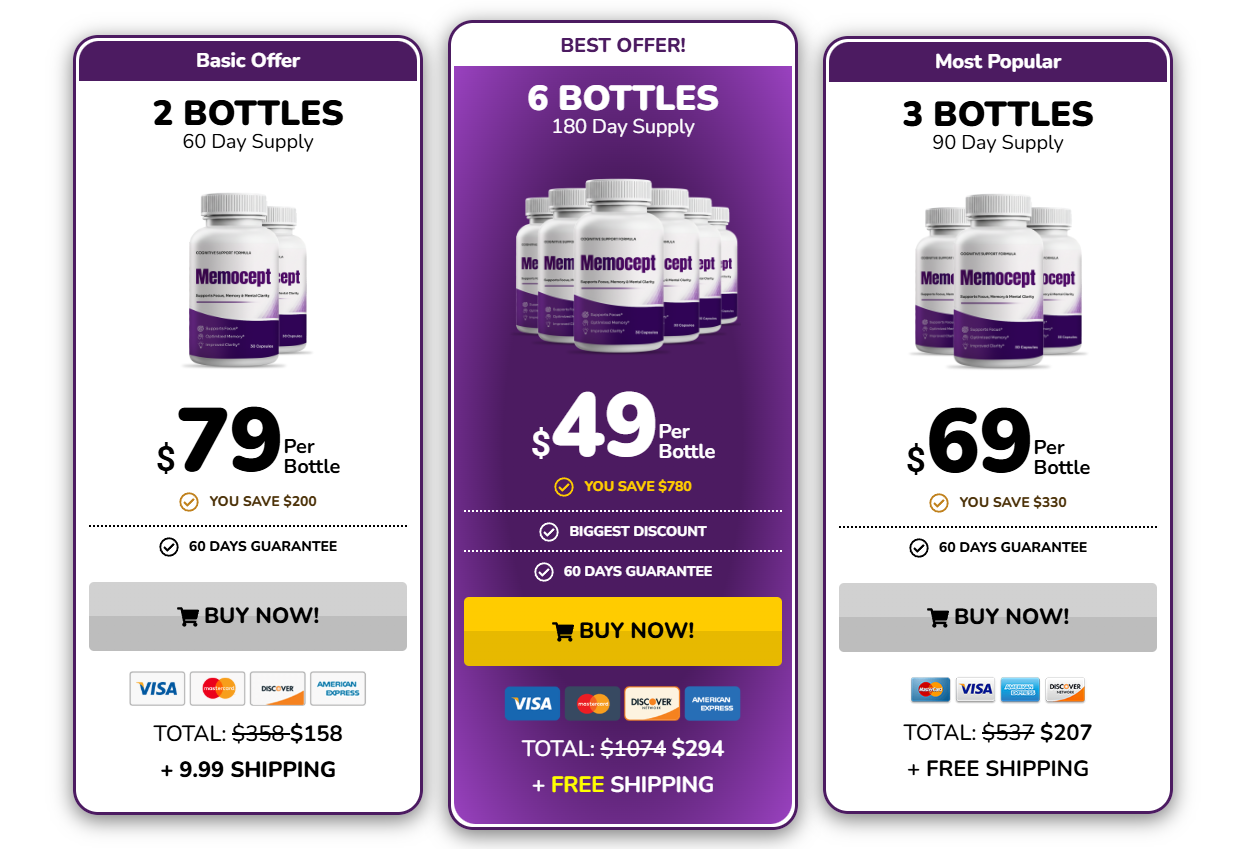
2 Bottles
$79 per bottle
60 day supply · Total $158
6 Bottles
$49 per bottle
180 day supply · Total $294 · Free shipping
3 Bottles
$69 per bottle
90 day supply · Total $207 · Free shipping
Prices shown reflect the packages advertised on the official store and can change during promotions.
The guarantee, and why it changes the decision
Every package is covered by a 60-day money-back guarantee running from the date of purchase. Sixty days is a genuinely useful window for this category, because it covers the period in which the benefits people actually care about are supposed to appear. A thirty-day guarantee on a formula that takes eight weeks to work would be close to meaningless; sixty days is not.
It also shifts where the risk sits. You are not being asked to bet on whether the formula works for your particular biology before you have tried it. You take it properly for two months and, if nothing has changed, you contact support and start the return. Keep the order confirmation, and start the process before the window closes rather than on the last day.
One caveat that matters more than any other on this page: the guarantee is tied to purchases made through the official website. Bottles bought from third-party marketplace sellers are outside it, and those listings are where expired stock and counterfeits appear. Buying direct is the only way the refund promise means anything.
Honest drawbacks
No review is worth reading if it only lists positives, so here are the fair criticisms.
It is slow. If you want something you feel today, this is the wrong category entirely, and you will be disappointed by week two. It is also not cheap at the smaller package sizes — the two-bottle option is the worst value on the page, and the pricing structure is clearly designed to push buyers toward the larger bundles. Results vary genuinely between people, because baseline nutrition, sleep, age and stress all change what a formula has to work with. And it is sold direct rather than in shops, so you cannot pick one up locally and you are dependent on shipping times.
Against those: the guarantee is long enough to be real, the per-bottle cost on the six-bottle package is reasonable for the category, and the approach — daily, cumulative, unstimulating — is the one that has the best evidence behind it for this kind of product.
Frequently Asked Questions
What exactly is Memocept?
Memocept is a daily cognitive support supplement sold in 60-capsule bottles. It is positioned as a brain-health formula for adults who want steadier focus, easier recall and less of the mental fog that builds up over a long working day.
How long before Memocept starts working?
Most people describe the first change as a slightly cleaner morning within one to two weeks. The deeper benefits people care about, like recall and sustained concentration, are usually reported after around eight to twelve weeks of uninterrupted use, which is why the multi-bottle bundles are the ones most buyers choose.
How do I take it?
The label direction is two capsules a day with a glass of water, ideally with breakfast or your first real meal. Taking it at the same time each day matters more than the exact hour.
Is Memocept safe to combine with other supplements?
It is a nutritional supplement rather than a medicine, but if you take prescription medication, are pregnant or nursing, or manage an ongoing condition, speak to your doctor before adding anything new. That is standard advice and it applies here.
What is the refund policy?
Every package is covered by a 60-day money-back guarantee from the date of purchase, so a first bottle can be tried and returned if it does not suit you.
Where should I buy it?
Only through the official Memocept website. Marketplace listings are where counterfeit and expired stock shows up, and those orders are not covered by the guarantee.
The verdict
Memocept is a sensible, unflashy entry in a category that is full of overclaiming. It does not promise a new brain, it does not pretend to be medicine, and it is built around the slow, cumulative approach that the research in this space actually supports. The three claims on the bottle — focus, memory, clarity — are the right ones to make, and the 60-day guarantee is long enough to let you test them properly rather than being asked to take them on faith.
If you decide to try it, do it properly: pick a package that covers at least three months, take two capsules every single morning, protect your sleep, and judge the result at the end of the window rather than at the end of week two. That is the only version of this experiment that will tell you anything useful.